The Focal Point for Wildlife works under the authority of the WOAH Delegate to bring wildlife disease information into reporting to WOAH. The Focal Point connects wildlife experts and authorities at national level with WOAH, and supports the collection and submission of wildlife disease information.
For WOAH-listed diseases in wild animals, reporting goes through WAHIS, where the Focal Point for Wildlife works with the Focal Point for Animal Disease Notification. For non-listed diseases and unusual health events in wildlife, the Focal Point for Wildlife can share information directly through WildEpi.
For what each report covers across all Focal Points, see Reporting to WOAH: what, when and where.
| Report | When | Your responsibility | Where | Procedure |
|---|---|---|---|---|
| Immediate notification | Within 24 hours of confirmation | In collaboration with the Focal Point for Animal Disease Notification* | WAHIS – Animal Disease Events module | Terrestrial |
| Follow-up reports | Weekly, until a final report is submitted | In collaboration with the Focal Point for Animal Disease Notification* | WAHIS – Animal Disease Events module | Terrestrial |
| Six-monthly report – terrestrial | Twice a year (indicative deadlines: mid-September for January–June, mid-March for July–December) | In collaboration with the Focal Point for Animal Disease Notification* | WAHIS – Six-monthly reports module | Terrestrial |
| ARAHIS (ASEAN Member States) | Monthly, since 1 January 2025 | In collaboration with the Focal Point for Animal Disease Notification* | WAHIS – Animal Disease Events module | ARAHIS reporting |
* The Focal Point for Wildlife provides the wildlife disease information. With their own WAHIS access, they can also contribute to submissions directly – for example, by entering occurrence codes for wild animals in six-monthly reports – with the Focal Point for Animal Disease Notification kept informed.
| Report | When | Your responsibility | Where | Procedure |
|---|---|---|---|---|
| Non-listed diseases, listed diseases in hosts outside the case definition, and unexplained events in wildlife | Ad hoc, as events are detected | Either Focal Point can submit | WildEpi | WildEpi Q&A |
| Non-listed diseases, and listed diseases in hosts outside the case definition, in wild aquatic animals | Ad hoc | In collaboration with the Focal Point for Aquatic Animals | WildEpi | WildEpi Q&A |
Article 1.1.5 does not apply to wild animals: a WOAH-listed disease in a wild host species outside the Code case definition, terrestrial or aquatic, is shared through WildEpi.
Access WildEpi (authorised users only)
WildEpi complements, but does not replace, official reporting to WOAH: WOAH-listed diseases in wildlife are still reported through WAHIS. To learn more about both platforms and how they fit together, see Reporting to WOAH: what, when and where.
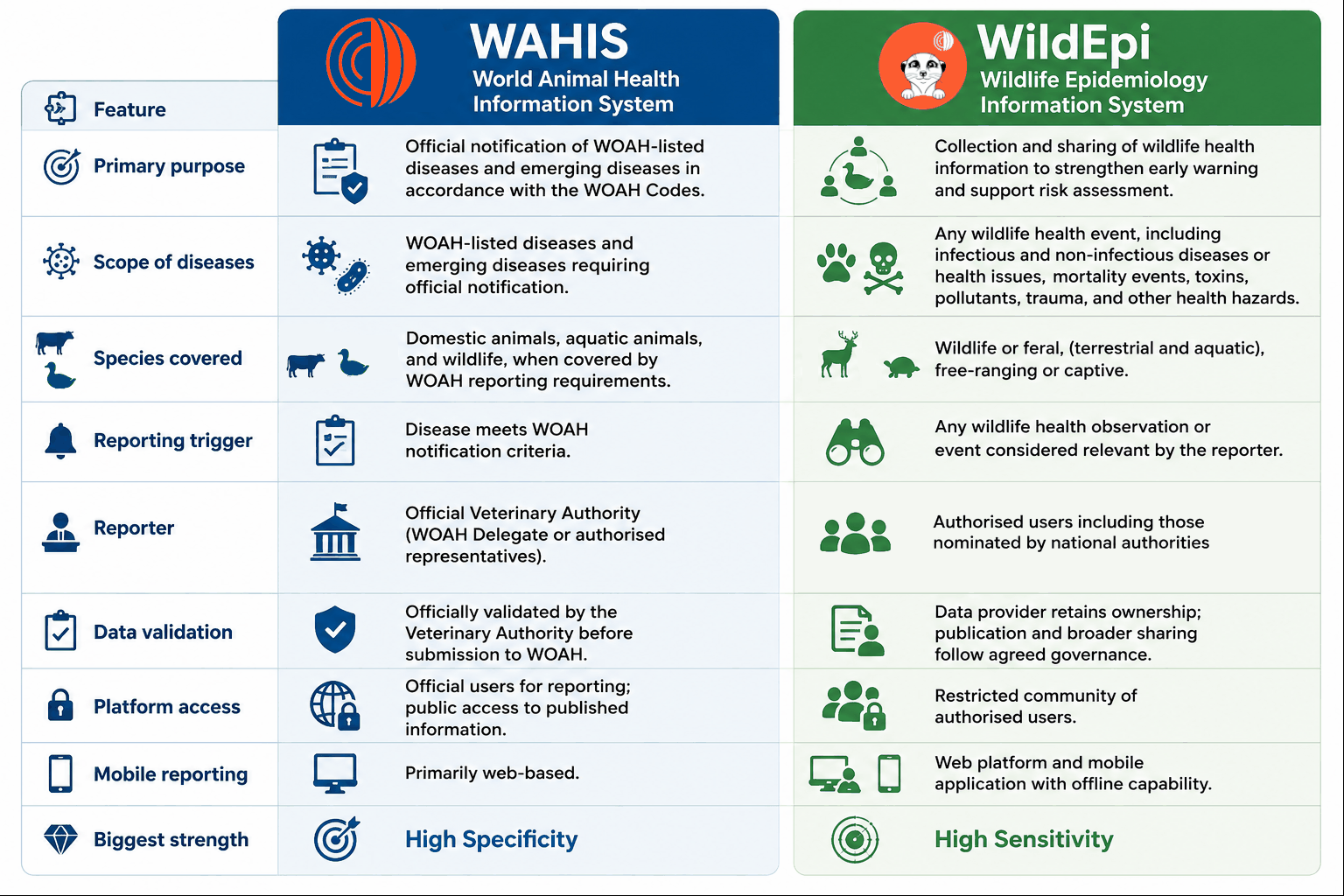
WAHIS and WildEpi at a glance – click the chart to open it at full size.
Who can use it. WildEpi is open only to members of the WildEpi community. New users are added by the Delegate, or by WOAH at the Delegate’s request.
What is reported. Any health event in wild animals that is not a WOAH-listed disease – diagnosed or not, infectious or not, even in a single animal – including deaths from environmental causes, negative test results and historical data.
How reports are shared. Reports can be entered one by one, uploaded in bulk from a spreadsheet, or recorded offline in the mobile app. Drafts are visible only to the reporter and the Delegate; Focal Points publish with the Delegate’s permission, after which reports are visible to the WildEpi community, and if decided, to the general public. The data provider remains the owner of the data.
If an event is later confirmed as a WOAH-listed disease, it is reported through WAHIS, in collaboration with the Focal Point for Animal Disease Notification.
WOAH does not prescribe which Focal Point submits which report: each Member decides how reporting is shared between its Focal Points. WAHIS access can be restricted by animal category (terrestrial or aquatic), but not by report type.
Immediate notifications are due within 24 hours of confirmation. The clock starts when the disease is confirmed, not when the information reaches the Focal Point who submits the report, so wildlife findings should be shared with the Focal Point for Animal Disease Notification straight away.