Every WOAH Member reports its animal health situation to WOAH through WAHIS, the World Animal Health Information System, in line with Chapter 1.1 of the Terrestrial and Aquatic Animal Health Codes. In Asia and the Pacific, two regional reporting streams run alongside: ARAHIS for ASEAN Member States, and RAAD for aquatic animal diseases. Wildlife health events that fall outside formal notification can be shared through WildEpi. This page shows how these pieces fit together and directs each Focal Point to the guidance for their role. It complements the WOAH global website and does not replace the Codes or the WAHIS notification procedures.
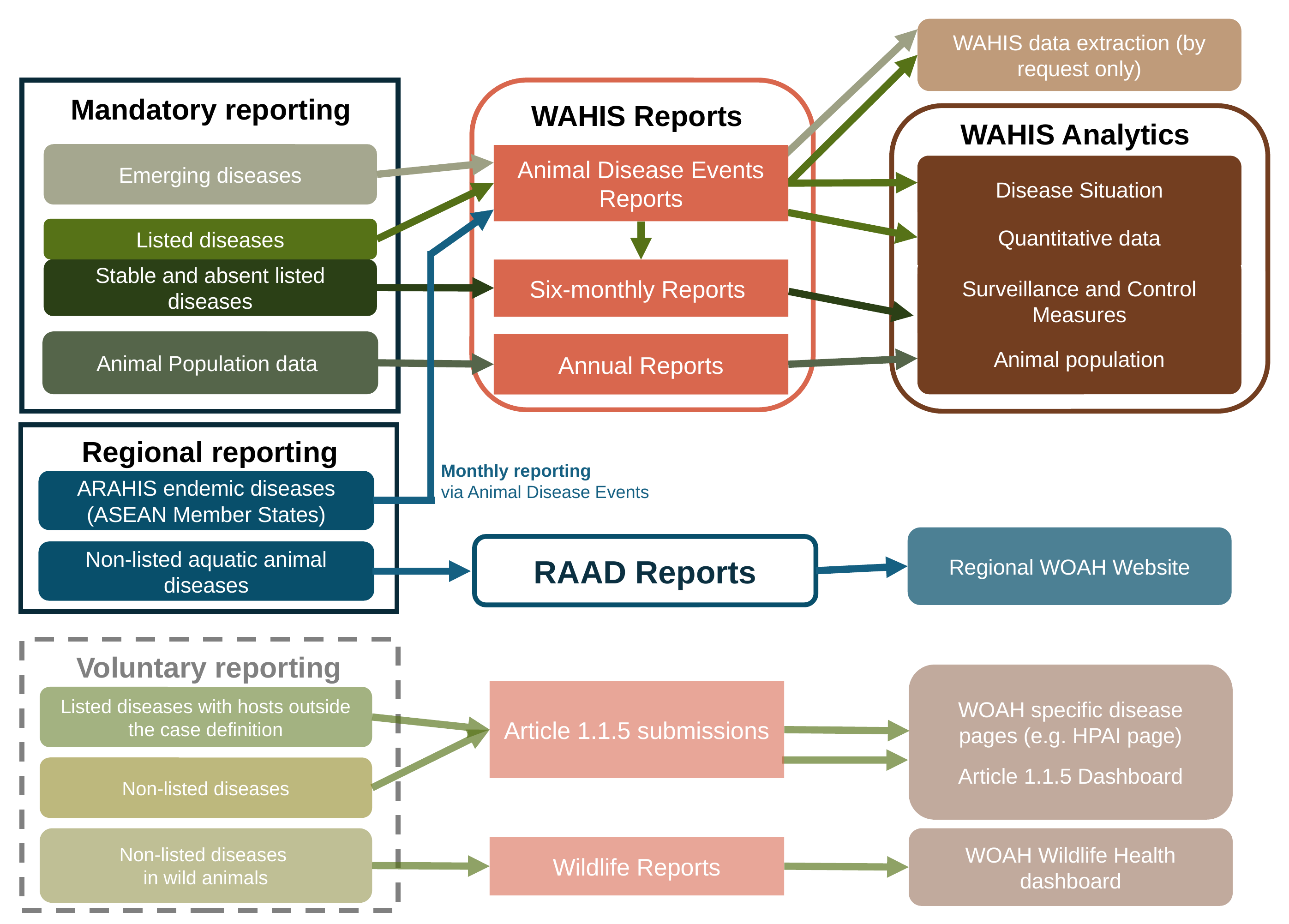
Click on the diagram to open it in full size.
Download the poster: What to report, and when? Quick guide for WOAH Focal Points (PDF, 1 MB)
| Report | What is reported | When | Where |
|---|---|---|---|
| Mandatory reporting to WOAH | |||
| Immediate notification | First occurrence or re-occurrence of a WOAH-listed disease, a new strain, a new host species, or an unusual change in disease behaviour (Article 1.1.3) | Within 24 hours of confirmation | WAHIS – Animal Disease Events module |
| Follow-up reports | Evolution of an event already notified | Weekly, until a final report is submitted | WAHIS – Animal Disease Events module |
| Six-monthly reports | Presence or absence of all WOAH-listed diseases; terrestrial and aquatic reports are submitted separately | Twice a year (indicative deadlines: mid-September for January–June, mid-March for July–December) | WAHIS – Six-monthly reports module |
| Annual report | Animal population and animal premises; terrestrial and aquatic data in one report | Once a year (available from 1 January, due by the end of April) | WAHIS – Annual reports module |
| Regional reporting – Asia and the Pacific | |||
| ARAHIS (ASEAN Member States) | Seven priority terrestrial diseases: foot and mouth disease, Newcastle disease, highly pathogenic avian influenza, classical swine fever, rabies, lumpy skin disease and African swine fever | Monthly, since 1 January 2025 | WAHIS – Animal Disease Events module (no separate ARAHIS platform) |
| RAAD | Non-listed aquatic animal diseases of regional importance | Quarterly | Excel form sent by email to the WOAH Regional Representation for Asia and the Pacific |
| Voluntary reporting | |||
| Article 1.1.5 | WOAH-listed diseases in hosts outside the Codes’ case definitions (e.g. HPAI in mammals), and non-listed diseases of epidemiological importance | Ad hoc | WAHIS Support Desk |
| WildEpi | Wildlife health events outside formal notification: non-listed diseases, unusual morbidity or mortality, undiagnosed syndromes. Not an official notification to WOAH. | Ad hoc | WildEpi platform (authorised users only) |
All reporting is carried out under the authority of the WOAH Delegate, who nominates Focal Points to prepare and submit reports. Each Focal Point has a dedicated page with their reporting responsibilities and supporting resources.
| Role | Reporting responsibilities | Platforms and pathways |
|---|---|---|
| WOAH Delegate | Overall responsibility for the Member’s reporting to WOAH; all reports are submitted under the Delegate’s authority. | WAHIS |
| Focal Point for Animal Disease Notification | WOAH’s first point of contact for reporting and the main submitter in WAHIS, including ARAHIS reporting for ASEAN Member States. | WAHIS, WAHIS Support Desk (Article 1.1.5), ARAHIS |
| Focal Point for Aquatic Animals | Aquatic animal disease reporting in WAHIS, as primary submitter or shared with the Focal Point for Animal Disease Notification, and quarterly RAAD reporting. | WAHIS, WAHIS Support Desk (Article 1.1.5), RAAD |
| Focal Point for Wildlife | Brings wildlife disease information into WAHIS reporting in coordination with the Focal Point for Animal Disease Notification, and shares wildlife health events through WildEpi. | WAHIS (with the Focal Point for Animal Disease Notification), WildEpi |
Each Member determines which Focal Point is responsible for submitting which reports, as WOAH does not strictly prescribe reporting roles. While WAHIS permissions can be configured by animal category (terrestrial or aquatic), they cannot be differentiated by report type.
WOAH Members report through WAHIS, submit Article 1.1.5 notifications through the WAHIS Support Desk, and share wildlife health information through WildEpi. In Asia and the Pacific, two regional pathways run alongside these: ARAHIS for ASEAN Member States and RAAD for aquatic animal diseases.
WAHIS public interface – consult published data
WAHIS reporting interface – for reporting, authorised users only
WAHIS (World Animal Health Information System) is WOAH’s central platform for the official notification, management and publication of animal health information submitted by Members. It supports timely and transparent sharing of information on WOAH-listed terrestrial and aquatic diseases, emerging diseases and other relevant animal health events.
Reports are submitted electronically in English, French or Spanish, as standard notification reports:
The reporting interface is a secure workspace for authorised users, principally WOAH Delegates and their designated Focal Points. Once validated, reports are published on the public interface, which holds animal health data from 2005 onwards.
A Focal Point needs reporting rights in WAHIS before submitting reports. The Delegate can grant these rights directly in WAHIS, or request them from the WAHIS team at WOAH Headquarters:
With the Delegate’s approval, additional colleagues can be nominated as substitute Focal Points to help enter data in WAHIS. Nomination forms for Focal Points
WAHIS Support Desk is the central point for help with WAHIS reporting and use of the system, for both new and experienced Delegates, Focal Points and reporting staff. It brings together practical support resources and lets authorised users send requests directly to the WAHIS team.
A one-time registration is needed to submit a request or report a technical issue; access is granted immediately.
Notifications under Article 1.1.5 are also submitted through the Support Desk, not through the WAHIS reporting interface. Use this pathway for events that fall outside the standard WAHIS notification categories but still need to be communicated to WOAH – for example, WOAH-listed diseases in hosts outside the Codes’ case definitions, or non-listed diseases of epidemiological importance. Procedure for reporting under Article 1.1.5
WildEpi platform – authorised users only
WildEpi is WOAH’s secure, voluntary platform for authorised wildlife health and One Health professionals to share information on wildlife health events in real time. It supports early warning, risk assessment and collaboration among Veterinary Services, wildlife authorities, environmental partners and other trusted contributors.
WildEpi complements WAHIS by capturing a broad range of wildlife health events that are not reported through formal notification pathways: non-listed infectious diseases, unusual morbidity or mortality, undiagnosed syndromes, environmental incidents, toxins and other non-infectious health concerns affecting any wild species.
Information shared through WildEpi is not an official notification to WOAH. Reporting is voluntary, and information is currently shared within an authorised community of users, not with the general public. Access is by invitation, through the Delegate or WOAH.
Contact: WOAH Wildlife team – [email protected]
Since 1 January 2025, ARAHIS (ASEAN Regional Animal Health Information System) reporting is done through WAHIS only – the one-portal approach. The separate ARAHIS platform has been decommissioned.
This applies to the 11 ASEAN Member States: Brunei Darussalam, Cambodia, Indonesia, Lao PDR, Malaysia, Myanmar, the Philippines, Singapore, Thailand, Timor-Leste and Viet Nam.
Seven priority terrestrial diseases are reported monthly through the WAHIS Animal Disease Events module: foot and mouth disease, Newcastle disease, highly pathogenic avian influenza (poultry and non-poultry), classical swine fever, rabies, lumpy skin disease and African swine fever.
Historical ARAHIS data are archived at the WOAH Sub-Regional Representation for South-East Asia: [email protected]
RAAD reporting collects quarterly information on non-listed aquatic animal diseases of importance to Asia and the Pacific. It runs alongside, not instead of, WAHIS reporting of WOAH-listed aquatic diseases.
Each quarter, Members share this information with the WOAH Regional Representation for Asia and the Pacific through a standard Excel reporting form, usually completed by the Focal Point for Aquatic Animals. The disease list is not closed: diseases of emerging regional concern that are not yet on the list can also be reported. Questions about RAAD can be sent to [email protected].
Regional Aquatic Animal Disease (RAAD) reports – RRAP project page