
One Health
2nd Quadripartite One Health Workshop for the Pacific
September 27, 2026
Read more
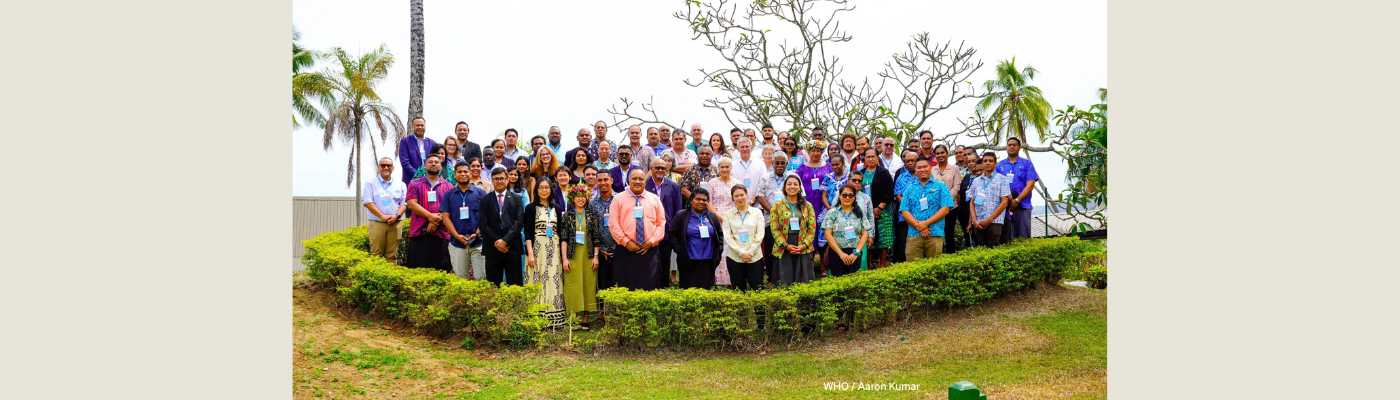
Photo: Participants of the second Quadripartite Pacific One Health Workshop in Nadi, Fiji (credit WHO / Aaron Kumar)
As a range of diverse health threats become increasingly interconnected, Pacific countries and areas are strengthening their ability to prevent, detect, and respond before the next pandemic or health, environmental and climate emergency strikes.
The challenges facing Pacific communities do not stop at the boundaries of a single sector. Preventing the next health crisis begins with understanding the connections between people, animals and the environment.
Across the region, Pacific countries and areas (PICs) are adopting an integrated approach known as “One Health” to prevent and mitigate health threats at the interface of humans, animals, plants and the environment. At the second Pacific One Health Workshop in Fiji, government representatives from the Pacific along with regional and international partners, reviewed progress made since the first workshop held in 2024. Representatives from the human health, animal health and environment sectors shared experiences and lessons learned, and identified practical actions for scaling One Health implementation across the Pacific.
Throughout the three-day workshop, government representatives and partners exchanged experiences on strengthening One Health governance, surveillance, risk assessment, pandemic preparedness, food safety, antimicrobial resistance, environmental integration and climate-related health risks.
Participants identified priorities for strengthening multisectoral coordination and improving preparedness and response capacities across the Pacific region.
The importance of a whole-of-society approach to One Health that involves governments, regional organizations, development partners, Indigenous Peoples and Local Communities, academia, women, youth and civil society was seen as vital to advance the approach.
The workshop reviewed progress and One Health related achievements made since 2024; examined key regional issues including health security, climate change, and zoonotic diseases; promoted knowledge exchange, networking and partnerships among stakeholders; and developed recommendations and priority actions to scale up implementation and strengthen coordination across sectors and the region.
Outcomes from the workshop are expected to contribute to stronger regional and national coordination, increased awareness, and continued investment in integrated approaches to health, food security and environmental sustainability across the Pacific.
The workshop was supported through funding from the Pandemic Fund, the Australian Department of Foreign Affairs and Trade, the People’s Republic of China, the Republic of Korea’s Korea Disease Control and Prevention Agency), and the German Federal Ministry for the Environment, Climate Action, Nature Conservation and Nuclear Safety.
It was jointly organized by the Food and Agriculture Organization of the United Nations (FAO), the United Nations Environment Programme (UNEP), the World Health Organization (WHO) and the World Organisation for Animal Health (WOAH), in collaboration with the Pacific Community (SPC) and the Secretariat of the Pacific Regional Environment Programme (SPREP).
The workshop is part of ongoing work of a quadripartite partnership among FAO, UNEP, WHO and WOAH to advance and operationalize the One Health approach at the human-animal-environment interface. The approach was endorsed in April 2026 by governments from around the world in Lyon, France, as an essential pillar to strengthen security within countries and across regions. It draws on the lessons of the COVID-19 pandemic and previous global health crises that demonstrated the linkages between human, animal and environmental health.
Working collaboratively with governments and partners, the Quadripartite supports countries in preventing, predicting, detecting and responding to health threats while promoting sustainable and resilient ecosystems and communities.